youth soccer season start San Antonio

Youth soccer is very popular in San Antonio. It is giving kids of all ages a chance to develop their skills, make friends, and stay active. Parents are also often excited to get their kids involved in the sport with a lively soccer community in the city. However, it’s important to know the season dates for effective planning.

As part of our San Antonio youth soccer club, we follow this guide. This guide offers an overview of the 2025 youth soccer season in San Antonio, including registration details, season timelines, and tips for parents to help ensure their child has a successful and enjoyable experience.

Overview of Youth Soccer Seasons in San Antonio

The youth soccer season in San Antonio is usually divided into three main parts: Spring, Summer, and Fall youth soccer in San Antonio. Each season offers different opportunities for kids of different ages and skill levels to participate in soccer.

·      Spring Season

The Spring youth soccer in San Antonio typically runs from late February to late April. This season is known for competitive play and often includes a mix of recreational and competitive leagues.

·      Summer Season

Summer is not a traditional season for soccer. However, it does offer various San Antonio soccer camps and clinics that keep players engaged and help them improve their skills. These programs are usually shorter and focus on skill development.

·      Fall Season

The fall season typically occurs from late August to late November. This season typically sees a high level of participation, as many players return after the summer break.

Youth Soccer Age Groups

In the US, youth soccer age groups are based on a child’s birth year. To determine which age group a player belongs to, simply subtract their birth year from the year the soccer season ends. For example, in the 2024-2025 soccer season, a child born in 2016 would be in the U9 age group.

It is because you would do the math like this:

(2025 minus 2016) = 9

Spring 2025 Youth Soccer Season

Registration for the Spring 2025 season typically starts in early January and closes by mid-February. Parents need to keep an eye on specific deadlines for different youth soccer leagues in San Antonio, as they can vary.

Season Start and End Dates

The Spring 2025 season is anticipated to commence in late March. Teams will have practices leading up to the first games, which usually start in late March. The season typically concludes by early June, with playoffs and championship games occurring in the final weeks.

Notable Leagues and Organizations Offering Spring (or Year-Round) Programs

Several leagues and organizations offer youth soccer programs in San Antonio, including:

  • Barcelona Premier Soccer Club (BPSC): Focuses on skill development and teamwork, providing programs for players of all levels. One of the top youth soccer clubs in San Antonio.
  • San Antonio Youth Soccer Association (SAYSA): A popular choice for recreational and competitive leagues for various age groups.
  • AYSO: It offers multiple youth soccer training programs, which include recreational and competitive leagues.

Summer 2025 Youth Soccer Opportunities

Summer 2025 is an excellent time for young soccer players to improve their skills through camps, clinics, and leagues. THis season soccer programs often focus on skill development, teamwork, and conditioning. Many local clubs and organizations host soccer camps which manage different age groups and skill levels.

  • Camps

These typically run from late June to early August and can last anywhere from one week to several weeks. Camps typically focus on specific skills, such as dribbling, passing, and shooting.

  • Clinics

These are shorter than camps. However, soccer clinics often offer specialized kids soccer training in San Antonio that focus on particular aspects of the game, such as goalkeeping or offensive strategies.

Key Youth Soccer Registration Dates

Registration for many programs usually starts in mid-May. Camps and clinics kick off in early July and go through mid-August. You’ll find specific details, such as times, dates, and locations, available in mid-May.

For example, NLSA Surf has a summer camp that begins on August 18th, and registration for that will open after the tryouts.

Benefits of Summer Participation.

Participating in summer soccer programs can provide numerous benefits, including:

  • Summer camps and clinics focus on improving technical skills in a fun and engaging environment.
  • Playing soccer during the summer helps keep kids active and maintain their fitness levels.
  • Summer programs offer children the chance to make new friends and connect with peers who share their interest in soccer.

Fall 2025 Youth Soccer Season

The Fall season is one of the most popular times for youth soccer in San Antonio, as many players return from summer breaks.

Registration Timelines.

Registration for youth soccer typically opens in the spring and summer, although schedules may vary depending on the location and league. Major organizations, such as US Youth Soccer and the National League, offer various programs and regional championships.

  • Many leagues offer discounts or other benefits for signing up early, which typically end around the start of summer.
  • Regular registration typically opens in the spring and summer, with deadlines that vary depending on the age group and league.
  • Some leagues may allow late registration, but this often comes with additional fees and limited availability of spots.

San Antonio Youth Soccer Schedule

Fall soccer seasons usually start in late August or early September. Many leagues, such as US Youth Soccer, host regional championships in June. The end dates for the season can vary by league. Some leagues finish in early November, while others continue into late November.

Major Leagues and Their Offerings.

  • US Youth Soccer offers various programs. These include national championships, regional championships, and club leagues.
  • The National League organizes both regional and national events, including regional championships and the National League Cup.
  • Additionally, local and state leagues typically offer a combination of recreational and competitive programs. For example, Barcelona Premier Soccer Club offers training programs and competitive leagues, emphasizing the development of skills and teamwork.

These leagues have different schedules and registration timelines. Therefore, it is essential to stay informed about the 2025 youth soccer registration in San Antonio. These options allow players to participate in soccer in various ways.

Choosing the Right Program for Your Child

Selecting the right soccer program for your child can be overwhelming, given the numerous options available. Here are some factors to consider:

Factors to Consider

  • Age

Different leagues cater to specific age groups. Therefore, it is crucial to find a program that aligns with your child’s age. For example, our Mini Cracks & Junior Cracks programs cater to kids as young as 4 years old, with structured sessions during both seasons.

  • Skill Level

Assess your child’s current skill level. Recreational leagues are great for beginners. However, competitive leagues may be better suited for more experienced players.

  • Location

Consider the distance to practices and games. Finding a program close to home can make logistics easier for busy families.

 Recreational Vs. Competitive Leagues

Recreational Leagues focus on fun, skill development, and sportsmanship. They are usually less competitive and are ideal for beginners.

On the other hand, competitive leagues often require tryouts and emphasize winning above all else. Players in competitive leagues typically have more experience and a greater commitment to the sport.

Tips for First-Time Soccer Parents

Here are some effective parent tips for youth soccer:

  • Don’t hesitate to reach out to coaches or league administrators if you have questions about the program.
  • Many leagues hold meetings for parents to discuss expectations, schedules, and other important information.
  • Encourage your child to practice and support their involvement in the team. Attend games and cheer them on!

Preparing for the Season

Preparing for the soccer season involves more than just completing registration. Parents should ensure their child is ready to play.

Necessary Equipment and Gear

Make sure your child has the following essential gear before the season starts:

  • Soccer Cleats
  • Shin Guards
  • Soccer Ball
  • Practice Gear, including moisture-wicking shirts and shorts.

Health and Safety Considerations

  • It is impotant that your child is physically fit to participate in soccer. A visit to the pediatrician may be wise if your child has any health concerns.
  • Encourage your child to stay hydrated. It is especially true during the hot summer months.
  • It’s a good idea to have a basic first aid kit readily available during practices and games.

Setting Expectations and Goals.

You should discuss your child’s goals for the season with them. Encourage them to focus on skill improvement, teamwork, and having fun. Remind your child that it’s okay to make mistakes and that learning is a natural part of the process.

Local Soccer Resources and Contacts

Here are the key youth soccer organizations in San Antonio:

Soccer Organization

Website Contact
Alamo Area Youth Soccer Association https://www.aaysa.org/ +1 877-229-7689
Barcelona Premier Soccer Club https://barcelonapremiersc.com/programs/ (210) 851-9869
San Antonio City Soccer Club https://www.sacitysc.com/ +1 210-880-5772
North East Youth Soccer Organization https://www.neyso.org/ 210-880-5772


As the youth soccer season in San Antonio approaches, parents need to be informed about key dates, registration details, and preparation tips. You can ensure your child has a positive and rewarding soccer experience. It is possible by understanding the structure of the seasons and actively participating in the process.

If you are looking for a great soccer program for your child, consider registering for the Barcelona Premier Soccer Club. We offer programs designed to foster skill development, teamwork, and a love for the game.

Barcelona Premier Soccer Club Programs Offering

BPSC offers a range of training programs available throughout the year, including special elite camps. Their main focus is on helping young players improve their skills using a unique approach based on the Tiki Taka method. This style of play emphasizes short passing and maintaining possession of the ball, which helps players improve their skills in the game.

FAQ Section

At what age should my child start to play soccer?

Children can start playing soccer as early as 3 to 4 years old. Many leagues offer programs specifically designed for this age group, focusing on fun and basic skills development.

How do I choose the right soccer league in San Antonio?

Consider factors such as your child’s age, skill level, and location. Recreational leagues are great for beginners, whereas competitive leagues are better suited for more experienced players. Research local leagues and ask for recommendations from other parents.

What equipment does my child need for the season?

Essential equipment includes soccer cleats, shin guards, a soccer ball, and comfortable athletic clothing. Make sure to check the league’s requirements for specific gear.

Are there any financial assistance programs for youth soccer?

Many leagues and clubs, including the Barcelona Premier Soccer Club, offer financial assistance programs to help families cover registration costs.

 

Top 10 Youth Soccer Drills to Boost Skills Fast

Soccer is more than just a game. It is a passion that teaches kids teamwork, discipline, and how to stay fit. Whether your child is just starting or has been playing for a while, doing the right youth soccer drills is crucial for improving their skills. The best beginner soccer drills can help your child improve their soccer skills, make the game more enjoyable, and boost their confidence on the field.

Let’s explore the top 10 best soccer drills for kids. These focus on key skills such as ball control, passing, shooting, and teamwork. These drills can help your child grow as a player and develop a love for the game with regular practice.

Why do Youth Soccer Drills Matter?

Youth soccer drills are crucial for developing the fundamental skills necessary to excel in the game. Here are some reasons why practicing these drills is important for young players:

  • Regularly doing drills helps kids improve their passing, dribbling, shooting, and ball control. These skills are the foundation of being a good soccer player.
  • Completing drills successfully boosts kids’ confidence and encourages them to take risks during games. It is important for their growth.
  • Many drills focus on working together. These are teaching kids how to cooperate and support their teammates.
  • Soccer drills keep kids active and help improve their overall fitness, making it a fun way to stay healthy.
  • Engaging in drills makes practice enjoyable. When kids find fun in their training, they are more likely to develop a lasting love for soccer.

Warm-Up Drills (Ages 4–17)

Here are some fun soccer drills for youth to know:

1.    Red Light, Green Light

This classic game is a fun way to get kids moving while teaching them to control their speed and direction. All players will dribble soccer balls in a designated area. When the coach yells “green light,” players should dribble fast. When they hear “red light,” they need to stop and place their foot on top of the ball. For “yellow light,” they should dribble slowly. It is great footwork training for soccer.

This drill promotes quick thinking and helps players develop their stopping and starting abilities, which are crucial in soccer.

2.    Toe Taps & Foundations

This drill helps players improve their touch and control of the ball while warming up.

Players stand with the ball in front of them. They alternate tapping the top of the ball with the soles of their feet (toe taps). Then, they touch the ball back and forth between their feet (foundations).

Encourage players to keep their heads up while doing this to enhance their awareness of the game. This drill not only warms up the players but also enhances their ball control and touch.

3.    Ball Control Drills

Soccer ball control drills teach a fundamental skill in soccer. This drill helps players develop their touch and handling skills.

To practice this drill:

  • Set up cones in a straight line, spaced about 2 feet apart.
  • Players dribble the ball through the cones using small touches.
  • Focus on keeping the ball close and using both feet.

This drill emphasizes control and precision, which are essential for success in matches.

4.    Dribble Relay

This drill is a fun way to practice dribbling while encouraging teamwork. For this:

  • Divide players into teams and set up a relay course with cones.
  • Players take turns dribbling the ball to the end of the course and back.
  • The next player can only go once the previous player has returned.

This relay drill fosters competition and helps players practice dribbling under pressure.

5.    Cone Weaving Challenge

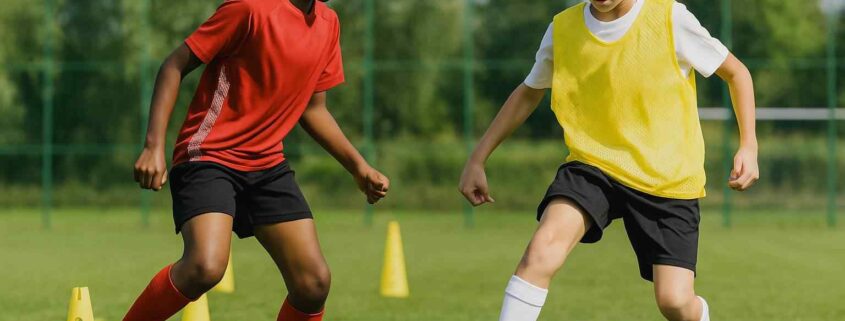
These agility drills for kids help in improving agility and dribbling skills. You can set up a line of cones spaced about 2 feet apart. Players dribble the ball through the cones, weaving in and out. After that, encourage your players to use both feet and maintain control of the ball.

The cone weaving challenge enhances players’ coordination and ability to move through defenders.

Passing & Shooting Drills

After your player has completed the soccer warm-up exercises, you can move to passing and shooting drills:

6.    Partner Passing

For partner passing, players form two lines facing each other. They take turns passing the ball back and forth, using both their right and left feet. Each player will complete a set number of passes before switching roles. This exercise helps improve passing skills and teamwork.

This drill also helps players develop precision in their passing, a crucial skill for maintaining possession during games.

7.    Target Practice

This drill is great for improving shooting accuracy. To set it up, place targets, such as cones or small goals, within the penalty area. Players will take turns shooting at these targets from different angles. Keep track of how many targets each player hits to create some friendly competition.

This target practice not only sharpens shooting skills but also teaches players to aim for specific spots in the goal.

8.    Shooting Accuracy Grid

It is another drill designed to improve shooting accuracy. This exercise focuses on shooting while incorporating movement. To play, create a grid using cones that represent different shooting zones. Players will dribble into one of these zones and attempt to shoot at a goal or target. Encourage them to think about where to shoot based on the goalkeeper’s position.

This drill simulates real game situations, which helps players make quicker decisions and improve their shooting under pressure.

Teamwork & Game Simulation Drills

Here are some drills that teach teamwork soccer activities:

9.    3v3 Mini Games

In this drill, play a 3 vs. 3 soccer game without goalkeepers. Have a third team on the sidelines waiting to join. It gives the players on the field a chance to rest and recover. You can switch to the third team after a goal is scored or every three minutes, whichever happens first.

Set up a playing area that is 25 yards by 15 yards, using cones and small goals. The smaller space keeps the action moving and allows for plenty of shots on goal. This drill encourages fast-paced play and helps players improve their skills.

10. Possession Keep-Away

This drill focuses on improving ball control and teamwork. To practice, divide the players into two teams. One team will attempt to keep possession of the ball, while the other team tries to win it back. Use a small playing area to encourage quick passing and movement.

Set a time limit for how long the possession team is allowed to retain possession of the ball. This keep-away drill helps players learn to move the ball quickly and effectively while working together as a team.

11.Final Goal Challenge

This drill simulates real game situations and enhances decision-making skills. To set this up, create a small goal and have players take turns trying to score after receiving a pass. Encourage them to think about where to shoot based on the goalkeeper’s position. You can also vary the distance and angle of the shot to make it more challenging.

The Final Goal Challenge enables players to practice shooting in realistic scenarios, thereby enhancing their ability to convert opportunities during games.

Tips for Parents in San Antonio

Your involvement in soccer training for kids can have a significant impact on your child’s soccer experience. Here are some tips to support their growth:

  • Set aside time each week for your child to practice these soccer drills at home, either alone or with friends.
  • Show your support by attending their games and practices. Your presence can boost their confidence and reinforce their commitment to the sport.
  • Encourage your child to have fun and enjoy the game, regardless of the outcome. Remind them that improvement takes time and dedication.
  • Look for soccer camps in the San Antonio area to supplement their training. Local clubs often offer excellent coaching and provide opportunities for competitive play.
  • Help your child set goals for their soccer development and regularly discuss their progress. Being involved in their journey will enhance their commitment and motivation.

What are the Next Steps?

Youth soccer drills are an excellent way for kids to develop essential skills while having fun. Incorporating these drills into their practice routine will help them become more confident players on the field. As they improve, consider enrolling them in a local soccer program to further develop their skills.

If you’re looking for a fantastic soccer experience for your child, consider joining the Barcelona Premier Soccer Club. We offer training programs tailored for all ages and skill levels, providing a supportive environment where young athletes can thrive and grow.

FAQs

At what age should kids start soccer drills?

Kids can start soccer drills as young as 4 years old. At this age, focus on having fun and developing basic skills to foster a love for the game.

How often should youth soccer players practice?

Ideally, youth soccer players should practice 2-3 times a week. Regular practice helps reinforce skills and improve overall performance.

Can I do these drills at home?

Most of these drills can be done at home or in your backyard with minimal equipment. Just make sure to create a safe space for practice.

Are there youth soccer classes near San Antonio?

Yes, San Antonio offers a variety of youth soccer programs, including camps, clinics, and leagues. Check with local sports facilities or the Barcelona Premier Soccer Club for more information on classes available in your area.

Top Finishing and Crossing Drills for Youth Soccer

Young soccer players require finishing and crossing abilities to improve their offensive gameplay. Placing balls precisely across can start scoring chances, and delivering them strongly will convert chances into targets. Players who can effectively put the ball into the goal and help teammates score achieve better match results.

Youth players enhance their skills and make smarter choices on the field when they practice their passing skills and goal-scoring methods. Regular training helps players memorize best practices, which they can reproduce in high-pressure situations. Young athletes who can precisely deliver crosses from wings and put the ball past the goalkeeper into the net get a significant competitive advantage.

This post explains the basic steps for teaching youth players to score and cross the ball by showing them how to shoot accurately and master their skills. Children in soccer can work with their teams and parents to access these training methods and improve their performance.

Top Soccer Finishing Drills for Youth Players

Soccer players must finish well to effectively turn their scoring opportunities into actual goals. Young soccer players must learn to shoot accurately with good control and trust in the scoring position. By practicing specific training exercises in this area, young players will improve their ability to score and make smart shooting choices. Practice drills teach players better goal-scoring decisions that boost their chances of scoring.

Understanding Finishing in Soccer

After the ball passes your foot, it needs more than just a good swing to score. Soccer finishing requires both perfect aim and good game awareness. 

  • Young soccer players must practice multiple shooting methods, such as instant shots, kicking from any direction, and direct contact with their feet. 
  • Players who perform well in intense situations become exceptional strikers rather than ordinary players. 

Finishing is one of those soccer skills that develops muscle memory with practice. That is why real-life practice with the ball in training and match situations is crucial for every youth soccer player.

Accurate Shooting and Keeping Cool Under Pressure

The target shooting drill is the top exercise for developing exact goal-scoring abilities. Each player stands at diverse spots inside their team’s penalty area and then tries to score the target zones near the opponent’s net. The drill helps players locate better shooting spots while teaching them to avoid direct attacks toward the goalkeeper.

  • The 1v1 finishing drill efficiently teaches players ball control under stress. In simulated conditions, the striker faces the goalie to practice fast thinking and directed goal-scoring skills. 
  • Players develop a better ability to stay relaxed through this training method.

The volleyball and half-volley practice helps coaches and players build dependable strike skills. After receiving a high pass, players must strike it before the ball reaches the ground. This drill teaches players to coordinate their movements and gain confidence while scoring from crosses or rebounds.

Scoring Under Pressure

Youth players often find it difficult to score in vital moments of play. The fast-paced finishing drill lets multiple players have quick shooting attempts toward the goal. This exercise builds scenario skills that require forwards to make fast decisions during real-game events.

The first-time shooting practice includes accepting a pass and then shooting the ball without a touch before playing it. Regular practice of this drill helps players gain first-time shooting comfort, which they need during time-sensitive moments in matches.

  • Youth players will enhance their match scoring chances by performing these daily shooting drills. 
  • Youth players must practice finishing drills consistently to boost their shooting accuracy together with their control and enhance their ability to make good decisions under stressful situations.

Mastering volleys alongside first-time shots and one-on-one situations gives players more confidence to transform their scoring opportunities into actual goals. 

The acquired abilities lead players to make superior choices in intense match conditions, strengthening their personal performance and their team’s results and developing a complete offensive system.

Best Crossing Drills for Young Soccer Players

When teams attack from wide areas, the game of crossing lets them make scoring chances. Youth players learn to hit accurate passes toward the penalty area by improving their crossing method, pass timing, and decision-making abilities. The team will reach better game results when players learn effective crossing drills.

Fundamentals of crossing the ball in soccer

Offensive players at winger and full-back positions depend heavily on crossing opportunities. Placing the ball properly across can open chances for forwards and midfielders to finish close to the goal. Players can handle various game moments when they know how to deliver low-driven crosses, lofted crosses, and cutbacks.

Drills to Improve Crossing Accuracy and Delivery

Enhancing crossing skill training includes focusing on the target crossing drill, where players make precise ball deliveries into defined areas within the penalty space. Young players become better at crossing when they direct their shots to positions where teammates can score rather than depending on the raw force.

  • During this drill, two players work together, and one crosses the ball from the wing area while the other tries to finish the play. 
  • This exercise makes both participants better at when to deliver and receive the ball. As training continues, more defensive players join the practice to create game-like simulations.

To build better execution of crosses, coaches should implement stationery and movement cross-training drills. Each training stage begins with crosses delivered from a fixed position before advancing to running crosses. Players learn to keep their technique precise while running fast in the attacking area.

Crossing Under Pressure

Players need to remain calm while performing crosses during game scenarios. The resistance drill adds a defender who guards the crosser, pushes them to find space, and makes precise passes when defenders challenge them. This training practice demonstrates on-field situations to develop smart choices during tough moments.

The early and late crossing drill shows players when to cross during the game. When poised deep in the field, players should cross the ball earlier for better results than waiting to reach the touchline. Young players improve their knowledge of effective ball delivery when they try multiple crossing positions and change when to pass.

Youth players need crossing drills to enhance their skill of accurate penalty area passes and scoring opportunities generation. Players can enhance their accuracy with practice through three key passing techniques, including lofted cross-motions, low-driven balls, and cutbacks.

The ability to time and position themselves on the field enables players to provide effective support to teammates, which boosts their goal-scoring opportunities and improves team-wide offensive coherence. 

Essential Soccer Training Exercises for Youth Teams

Youth teams should blend regular training activities that improve ball handling, passing, and team movement toward the opposition’s goal. 

These offensive practice routines help players develop better skills while learning to work in motion and with tactical strategies as a team. Youth players need formal training exercises to establish basic attacking skills to benefit them during matches.

Combining Finishing and Crossing Drills

The same result becomes more realistic when finishing and crossing skills practice is extended into team training scenarios. We organize an attacking drill by having wingers cross the ball into the box with strikers and midfielders running at set moments to attack. The drill strengthens teamwork between all team positions through coordinated actions.

The small-sided finishing and crossing game helps players develop both abilities by showing their skills in confined spaces. 

The practice utilizes a small field space to help players perfect their crossing and shooting skills around the box. Team members can respond swiftly with accurate passes and move effectively among players to score goals.

Offensive players should receive training in all necessary attacking abilities.

Youth team members need training exercises that promote successful attacking plays. During the possession-to-attack drill, players graduate from holding onto the ball to delivering valuable crosses and shots at the right moment. Through this drill, players learn to determine when attacks begin and move fast in response.

Players learn to make direct, brief passes through passing and movement training before making the last pass into the box for a goal attempt. The drill teaches players to see scoring chances by practicing in real game scenarios.

Youth teams with these training routines will learn to attack better by combining crossing routines with forward movement and finishing accuracy. Mandatory training exercises throughout team sessions enable youth players to achieve powerful ball-handling skills, accurate passing techniques, and game comprehension abilities.

Players learn through these drills to enhance teamwork and decision-making velocity, along with moving beyond the ball effectively. A trained player combination emerges through their learning of pass execution and timing runs, which results in scoring opportunities enabling joint tactical action against defences before match time, thus strengthening team unity. 

Final Words

The basic offensive gameplay improvement for soccer players in development requires focusing on finishing and crossing abilities. Effective development of these skills needs daily practice, simulated match conditions, and pressure-sensitive accuracy and composure.

Drills that are carefully developed allow youth players to enhance both their goal-scoring abilities and their ability to generate scoring opportunities for their teammates. The drills presented in this guideline enable young players to acquire goal-front traits of self-assurance, precision, and situational understanding.

Through training combined with dedicated effort, these techniques will improve match results, creating the base for soccer success in the future.

U8 soccer promotes game affection development through playful drills that teach basic skills to children during an exciting learning experience. U8 players require drills that shape creativity, teamwork, and technical abilities. The correct mixture of educational content and fun activities should be maintained for maximum motivation and participation from children.

U8 soccer drills, which use well-planned techniques, incorporate crucial abilities, including ball handling, passing and shooting, and coordination performance, in addition to sustaining an active atmosphere.

Along with enhancing technical ability, the drills allow children to elevate their social and spatial recognition skills while developing teamwork competence. Young players stay focused on their learning development because coaches use enjoyable challenges that create an exciting environment to enhance progress. 

Fun Soccer Drills for U8 Players

Developing basic soccer skills and enjoying practice sessions should be the main focus of U8 training. Fun exercises enable young players to gain self-assurance and master their body movement while building their ability to coordinate movements. Interactive drills help children develop by maintaining player interest and driving learning progress.

Dribble and Shoot Challenge

The drill enables young athletes to practice their ball-handling and shooting abilities while facing competition. Players should dribble between different marked cones from the starting point as they develop their touch control and foot agility.

As they approach the last cone, they shoot at the goal to hit the target using a powerful and accurate shot. Trainers enhance difficulty by deploying defenders or using specific target zones in the goal area. The drill enables players to develop ball control, agility, and finishing skills in an active game environment.

Traffic Jam Dribble

The exercise involves numerous players moving their balls inside a restricted space while staying away from other participants. Every player must maintain ball proximity and perform compact touches with deliberate movements when they alter direction between other players.

The coach controls difficulty by adding defending players or imposing specific patterns for player footwork during drills. This drill helps players develop their space identification abilities, pressure dribbling skills, and fast responses when many players are nearby.

Passing Relay

Teamwork, communication skills, and accurate passing are the main focus of passing relay drills. Multiple teams of players stand from a single line facing towards each other. The teams compete in rapid passing exchanges between teammates to reach their required number of passes before the opposing teams.

The coach can make passing practice more challenging by raising the passing length, requiring one-touch passes, and implementing moving targets. Players gain skills in passing techniques, quick decision-making abilities, and efficient ball distribution through this exercise.

Shark and Minnows

The drill generates enjoyment because it enhances athletes’ ball moves and their defensive abilities. The middle area becomes the base for multiple sharks who try to steal ball possession from all remaining players called minnows who attempt to pass through. The sharks prevent ball possession by trying to steal kicks while all players who lose the ball become part of the shark team.

The game ends with either one or two last surviving minnows taking victory. The exercise provides novice players with essential skills in ball protection combined with swift directional transitions and maintaining their composure while under pressure. 

Freeze Tag Soccer

The tagger group maneuvers through the target area to freeze other players who maintain control of the ball. Players who receive a tag must stop playing immediately and keep their ball while waiting for a teammate to unfreeze them through a ball-passing maneuver between the legs.

Time expires when all team members freeze or when the pre-established limit ends. This exercise tests both players dribbling endurance, team cohesion, and player alertness.

Small-Sided Scrimmages

During 3v3 or 4v4 small-sided games, young players can experience game-like scenarios while applying their game skills. During restricted field sessions, each player gets increased ball contact, better chances to make decisions, and improved tactical capabilities.

The coach implements changes by limiting the contact number per player, incorporating neutral players into the field, or offering benefits for fast-passing actions. The combination of small-sided activities boosts team understanding, player positioning and passing abilities, and team dynamics through a dynamic and exciting practice format.

Obstacle Course Dribbling

Incorporating obstacle courses provides both enjoyment factors and necessary development for dribbling fundamentals. To master this exercise, players need to navigate their ball through cones between their feet while clearing their legs and feet through hurdles and poles and jumping over small barriers to keep the ball under control.

The coach determines the difficulty level by deciding tabletop arrangements, introducing opposition players, and establishing dribbling conditions. Actual game readiness increases when players participate in this drill because it develops footwork agility, spatial coordination, and body control skills in confined areas. 

Teamwork and Coordination Drills for Young Players

Young soccer players require teamwork development as an important foundation in their training process. These drills establish teamwork by requiring U8 athletes to share information and distribute passes through which they learn group strategy fundamentals.

Pass and Move Drill

The training exercise demonstrates to players the correct reaction following passing the ball. To improve teamwork and positioning, the players must deliver the ball before they immediately transition to the available space on the field. This drill teaches players how to generate open areas on the field while showing them the importance of smooth ball circulation.

Follow the Leader Passing

The drill consists of one leader who guides fellow players through passing motions that all players imitate with passes. The drill incorporates instruction following, coordination, and teamwork fundamentals so young athletes can maintain unity throughout matches.

Triangle Passing

The players organize themselves into a triangular pattern before moving to practice ball passing. During this drill, players develop their passing accuracy and position awareness, improving their teamwork abilities to become ready for game scenarios.

Tunnel Passing Game

A third player tries passing the ball between two other players whose legs form a “tunnel” position. Team performance improves combined with passing accuracy and enjoyment through this specific drill.

Age-Appropriate Soccer Drills for U8 Players

The motor skills of U8 players remain in development; therefore, their practice sessions must consist of basic techniques and playful games to learn properly. Soccer drills designed for different player ages let younger participants enhance their abilities as they enjoy the game.

Ball Mastery Basics

Ball control becomes stronger through basic ball contact exercises, toe-tapping methods, and inside-outside dribbling principles. The basic techniques develop into advanced soccer skills as players develop.

Balance and Coordination Exercises

Combining hopping activities with dribbling and balloon-keeping activities supports children’s balance control and effective movement coordination. Basics in soccer movements need body control; therefore, these activities guide children towards this skill development.

One-on-One Mini Games

When smaller two-player matches occur, children learn to build their confidence for attacking and defensive actions. A controlled environment enables players to effectively learn defensive skills and past-opponent dribbling techniques.

Goal Scoring Fun

The target-shooting format of “hit the target” in shooting games lets kids improve their goal accuracy and goal-confidence abilities. Goal-scoring entertainment boosts players to fire more shots and refine their endpoint abilities.

Dribbling Drills for U8 Soccer Players

The fundamental soccer technique of dribbling shapes up as an ability that children must learn at the beginning of their soccer experience. Players can advance beyond defenders by utilizing this skill and keep playing the ball securely, no matter the situation. The U8 player’s development is boosted through enjoyable and active dribbling exercises, which refine their dribbling abilities.

Red Light, Green Light Dribbling

Players should move forward by dribbling their balls during “green light” commands yet stop when the coach announces “red light.” The activities develop players’ skills through ball control practice and build reaction and listening abilities.

Zig-Zag Dribble Course

Players navigate the cone pattern with ball control during this exercise through a crisscross movement. The drill enables players to develop their agility and improved dribbling precision and coordination.

Pirate’s Treasure Hunt

During the game, players must grab cones as treasures from multiple locations, but they need to evade defenders who play the role of pirates. The game-style drill allows players to develop their ball control and movement while making important decisions.

King of the Ring

All participants receive one ball to both shield it from opponents and try to eliminate their opposing balls from the field area. Dribbling under pressure and defensive awareness skills are developed through this specific exercise.

Escape the Defender

The defensive player operates alone while the offensive player tries to evade them on their way to the target. The drill replicates actual game situations to assist players in building up their dribbling skills with self-confidence and innovative moves.

Final Words

U8 soccer players need enjoyable drills and the right skills to develop their abilities with confidence in an encouraging training atmosphere. The process of developing enthusiasm for the sport equals the importance of learning new abilities at this developmental stage.

Training success occurs when coaches develop appropriate physical activities that combine ball control techniques with teamwork skills and attack procedures. Young players engaging in repeated training sessions under positive encouragement achieve better skills performance goals.

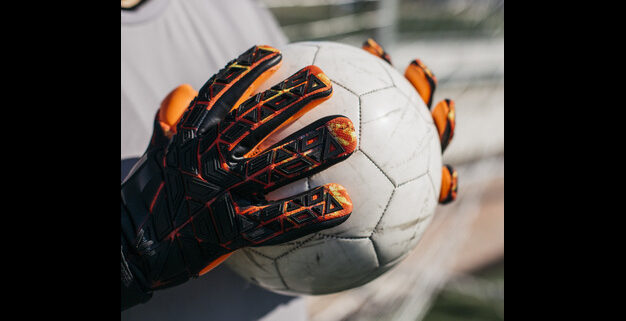
Goalkeeper gloves remain essential for soccer goalkeepers because they provide support while maintaining secure grips and comfort on the field. Proper glove sizing delivers enhanced ball control and injury prevention benefits.

Proper glove fit becomes a problem for numerous players since most cannot find suitable gloves, which results in performance reduction on the field. This briefing demonstrates the correct method to get precise measurements of your goalie glove dimensions while sharing important guidelines for suitable glove selection.

Professional sizing matters for new and experienced goalkeepers because it will enhance both performance abilities and glove fit.

Goalie Glove Sizing Basics

With goalkeeping gloves, you must understand fundamental size measurements before starting the measurement process. The size system for goalkeeper gloves operates independently from other soccer equipment standards. In glove sizing methods, the focus stretches beyond hand length measurements to treat hand circumference and finger proportions alongside it.

The input allows manufacturers to design gloves that mold to the hand exactly yet maintain adaptability when moving. Youth and adult gloves receive numbers 6, 7, 8, and 9, while adult sizes maintain the same pattern. Larger hand sizes might need to be selected between full sizes to attain a perfect fit.

An ideal fit allows minimal stretching of both your fingers and hand palm area without causing any performance reduction. You need to grasp these basic terms to achieve proper field performance from your chosen gloves.

Step-by-Step Measurement Guide

The correct process for accurately measuring your hand’s dimensions enables you to choose appropriate goalie gloves properly. The defined performance process results in glove fit, which leads to improved effectiveness. Below are the detailed steps to measure your hand for goalie gloves:

1.  Measure Hand Circumference

You should use a flexible tape measure to wrap it once around your palm at its widest point, just underneath the knuckles. Avoid including your thumb when making measurements because glove sizing does not require it. Record the tape measurement in inches to identify the circumference. The glove width, together with its fit, depends on this measurement.

2. Measure Hand Length

Place your hand gently on a well-flat surface, and then measure its length, starting from your middle finger tip to the base’s edge. The glove fit needs this measurement length for comfortable palm placement and finger containment.

3. Account for Extra Room

Keep one inch beside the largest measurement you recorded between your hand circumference and length. An extra inch between your glove measurements enables better movement while wearing your gloves to avoid discomfort.

4. Check Both Hands

In most cases, the hands have a minor difference in size, with one being somewhat larger than the other. When selecting your glove size, use the larger measurement taken from your hands. The method guarantees optimal glove dimensions that suit your dominant hand.

5.  Consult a Sizing Chart

Compare your hand measurements with the manufacturer’s sizing guidelines for gloves. This step ensures you choose the right glove size from different brands since their measurement systems only yield slight differences.

Custom hand measurements ensure you won’t experience glove discomfort, thus building both performance and physical comfort in matches.

See Also How to Wash and Dry Soccer Cleats in 5 Easy Steps?

Goalie Glove Size Charts

The glove manufacturers supply standardized size charts, which help participants find their perfect fit. Below is a general reference chart:

Youth Sizes

  • Size 4: Hand circumference of 5–6 inches
  • Size 5: Hand circumference of 6–6.5 inches
  • Size 6: Hand circumference of 6.5–7 inches

Adult Sizes

  • Size 7: Hand circumference of 7–7.5 inches
  • Size 8: Hand circumference of 7.5–8 inches
  • Size 9: Hand circumference of 8–9 inches
  • Size 10: Hand circumference of 9–10 inches

The glove dimension charts differ slightly between different manufacturer brands. Ensure your glove manufacturer gives you proper charts that accurately reflect their products’ sizes.

Tips for Choosing the Right Goalie Gloves

Measuring goalie gloves approval extends past dimensions alone. All ,glove elements including the materials and features, and design choice, actively affect performance outcomes. This guide presents several important guidelines to assist you with your selection.

·  Consider the Material

Goalie gloves typically exist in two material forms, including latex and synthetic components. Gloves from latex material create outstanding hand grip, which works perfectly for professional gameplay, yet their lifespan is shorter.

Synthetic gloves stand out because their extended durability pairs with monetary affordability and are suitable for training exercises and intensive surfaces.

· Look for Finger Protection

Your athletic goal should include finger-protecting gloves because frequent finger injuries are expected. Special finger-strengthening spines and inserts inside these gloves stop players from bending their fingers backwards while playing. Pure latex version of catcher gloves produces superior safety features at no expense to movement, so players of every age group can use them in competitions.

·  Decide on the Cut

How material threads into glove structure determines glove cut design. A secure glove fit exists in roll-finger devices since they allow great ball control. Flat palm gloves provide peak comfort during matches of extended duration because they have a relaxed fit and cushioned protection.

Hybrid glove cuts merge rolling finger and flat palm gloves to deliver protective capabilities and comfort properties.

· Ensure Sufficient Padding

The correct padding absorbs shock to assist the player when blocking high-energy shots. As you shop for gloves, find products that include generous palm and backhand padding. Padding should be sufficient in your tennis gloves, but excessive padding might lower your grip flexibility, so finding a thickness that matches your playing method is vital.

· Try Before Buying and Check Return Policies

Gloves testing should be possible before purchase to verify a proper fit. To purchase gloves online, verify with the vendor that they allow exchanges when the fit does not match your size. Peak field performances require both comfort and confidence for athletes.

Working through these considerations enables you to find gloves that support your overall needs and enhance your goalkeeping conduct.

See Also Dynamic Stretches for Soccer Matches: Boost Your Agility and Prevent Injuries

Goalie Glove Fitting Problems and Solutions

The usage of appropriate measurement techniques does not eliminate potential fit-related problems. Below are some common fitting problems and practical solutions:

1. Gloves Feel Too Tight

Wearing gloves that feel too snug indicates inaccurate measurement, so try a one-half the size and larger glove. Too-small gloves create performance issues by limiting movement and reducing blood flow to play-dependent hand muscles. Remember to add an extra inch to your sizing measurements.

2. Gloves Are Too Loose

Incompetent ball handling occurs when loose-fitting gloves fail to stay put when security matters. You should readjust and tighten the wrist straps. When the issue continues to be present, you should pick a glove that is one size smaller than your normal selection. Gloves need to provide wearable security without limiting your range of motion.

3. Fingers Feel Cramped

You can tell gloves offer a poor fit when your fingers remain cramped since either the lengths match your hands badly or the stitch design doesn’t match your hand structure. Stretch gloves with extended finger lengths and consider roll finger designs if hand spacing remains an issue.

4. Palm Feels Slippery

A slippery glove interior may indicate improper hand coverage because of a lining problem. Your selection of correct glove size matters, and you should choose materials with enhanced grip potential or integrated anti-slip properties for maximum control.

Resolving these typical problems results in improved fit alongside enhanced goalkeeper comfort and satisfaction. Glove selection requires patience when you try out various sizes and styles. This process later leads to game improvement.

Materials and Design of Goalie Gloves

The choice of materials in goalkeeper gloves creates differences in comfort, durability, and performance abilities. Latex material forms the palm inside the glove, giving wearers outstanding grip quality and protective element. Synthetic palms supply longer durability than natural counterparts yet provide a reduced grip performance.

Breathable fabrics and padded materials constituting the back side of gloves help protect athletes. Mesh panels added to gloves allow air circulation that stops your hands from sweating. How gloves close around the wrist determines their fit and adjustability.

See Also Science Behind Soccer: Analyzing the Game’s Strategies and Techniques


Custom Goalie Gloves vs. Standard Gloves

Customizable goalie gloves represent an option for athletes seeking perfect hand dimensions alongside chosen design elements. The gloves are personalized to your hand sizes, which ensures maximum comfort and performance benefits.

Through customization options, players can select the preferred materials while choosing colors and adding features, including finger protection and personalized logos. Due to their tailored nature, custom-made goalie gloves require greater production time and cost more money.

Regular gloves are easily accessible to players while serving the requirements of different players through their basic general fit configuration. The current selection includes gloves in different styles and sizes, which support various customer needs and financial ranges.

Conclusion

Accurate measurement of goalie glove size is essential because it leads to better performance and improved wearer comfort. Enhanced grip performance, easy control, and strategic protection, becomes possible through gloves that fit securely.

Proper glove selection follows learning basic sizing information, measuring correctly, and examining size charts. When selecting gloves, choose between standard or custom options by prioritizing materials and ensuring they fit your requirements.

When you address common fitting issues, you stay focused and confident on match day. Objective soccer gloves allow keepers to advance their playing abilities and minimize dangerous sideline incidents.

dynamic stretching


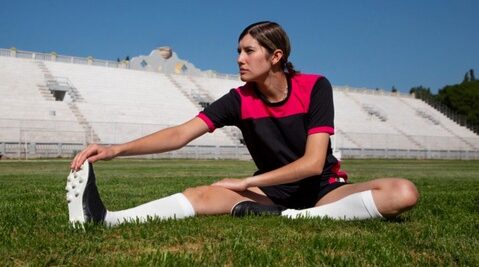
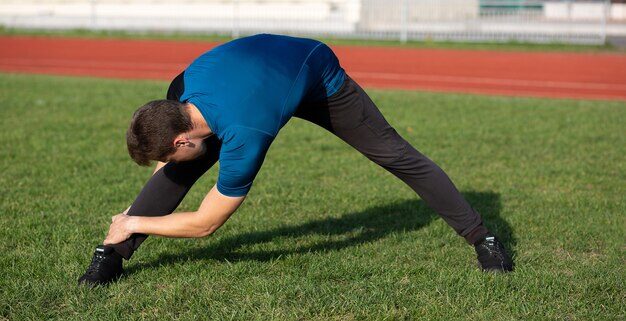
All soccer matches require dynamic stretching as a crucial workout component. Our performance improvements come alongside a substantial decrease in injury risk through these movements. You will get better flexibility and agility alongside increased athletic readiness by performing dynamic stretches before a match.

Additionally, this guide examines why dynamic stretching matters for soccer players and demonstrates potential techniques with benefits they derive from utilizing these stretching methods.

What Are Dynamic Stretches?

Dynamic stretching requires controlled movements allowing your joints and muscles to progress through their complete spectrum. Dynamic stretches differ from static stretches because their continuous nature duplicates soccer game movements yet requires no prolonged physical retention of specific positions.

The exercises help your body heat up, increasing blood circulation to your muscles and enhancing joint flexibility. Soccer players’ success depends on dynamic stretching, which prepares them for their sport’s demands, including direction changes, explosive jumping, and quick sprinting.

These body-activation movements train your body to succeed in anticipated physical challenges and boost your coordination and stability. Through dynamic stretching, multiple muscle groups work together simultaneously, ensuring your body is prepared for soccer’s sophisticated physical demands.

See Also Science Behind Soccer: Analyzing the Game’s Strategies and Techniques


Essential Dynamic Stretches for Soccer Players

Your performance will improve while you decrease the chances of soccer-related strains and sprains by including dynamic stretching to activate your core muscle groups during routine workouts. Dynamic stretching prepares your body for soccer’s intensive physical challenges by improving joint flexibility and mobility.

Read through these fundamental stretching routines, which focus on significant muscle groups to increase your soccer performance.

·       Leg Swings

You gain hip flexibility through leg swings, which helps your legs perform better when running and getting ready for kicks. To maintain balance, position yourself by a wall while extending one leg forward and back in controlled movements throughout 10–15 repetitions on each leg. Each elbow swing should extend to greater distances.

·       Walking Lunges

Walking lunges help strengthen all major lower body muscles, including the glutes while building better hip flexibility. Begin with a full stride using one foot before lowering your body to perform a 90-degree bend at the front knee, and then propel your movement with the back foot. Perform this exercise set 10–12 times across each lower limb.

·       High Knees

High Knees exercise your cardiovascular network while teaching you sprinting motion. Perform light jog movements while raising your knees to maximum height while moving forward with your arm swinging to preserve speed and momentum. You should hold this exercise movement between 20 and 30 seconds to gain stronger agility with better movement coordination.

·       Arm Circles

Yoga arm movement helps activate shoulder joints through shoulder exercises and develops upper-body flexibility. Move your arms steadily through full rotational motion from a wide palm position to larger circular patterns. Perform 10-15 seconds of movement before doing the opposite direction.

·       Dynamic Hamstring Stretch

You should perform the dynamic hamstring stretch because it effectively stretches your important sprinting and kicking muscles (hamstrings). Move ahead with one leg, which remains straight, then lean forward slightly while reaching toward your toes; after performing each set, switch to the other leg 8 to 10 times.

See Also Rise of Women’s Soccer: Celebrating Female Athletes and Their Achievements


Pre-Match Warm-Up Routines for Soccer

Developing an organized warm-up practice containing energetic stretching techniques remains essential for peak athletic results and medical protection. Here’s a step-by-step guide to creating an effective warm-up:

1.    Light Jogging

A warm-up should start with five to ten minutes of easy jogging, raising your heart rate and improving blood flow.

2.    Dynamic Stretches

Leg swings combined with walking lunges, high knees, and arm circles should form part of your workout to stretch important muscles and promote flexibility.

3.    Sport-Specific Movements

To simulate real game activity, integrate dribbling and passing exercises and short sprint drills that work your body through dynamic movements.

4.    Gradual Acceleration

Short bouts of speed increases through sprinting movements will properly equip your body to execute match-intense actions.

5.    Team Coordination Drills

The session concludes by having teams perform coordinated passing sequences followed by smaller-scale games that develop teamwork abilities and sharp focus.

Pre-match preparation that includes every aspect prepares you both physically and mentally for the competition.

Injury Prevention: How Dynamic Stretches Reduce Soccer Injuries

Soccer-related injuries have been proven most effectively reduceable through dynamic stretching techniques. Before playing soccer, the muscles, joints, and ligaments benefit from warm-up movements that prepare them to handle match intensity. Here’s how they help reduce injuries:

  • Increase Muscle Elasticity: Through dynamic stretches, your muscles gain flexibility, reducing strains’ chance.
  • Improve Joint Mobility: Flexible joints from leg swings and walking lunges work to decrease your chances of getting sprains.
  • Enhance Blood Flow: Dynamic stretching boosts circulation throughout your body to transport oxygen and nutrients, which prevents common fatigue injuries.
  • Reduce Muscle Imbalances: During games, stretching your underutilized muscles improves balance and coordination, especially around moving periods.

Specific injuries that soccer players frequently experience,, such as hamstring pulls, groin strains, and ankle sprains,, are prevented by dynamic stretching methods.


Agility Drills to Combine with Dynamic Stretches

A soccer performance will reach its highest level if you combine agility drills with dynamic stretching techniques. A joint approach of stretches improves your field performance by enhancing speed and coordination while reducing reaction time.

·       Ladder Drills

Various ladder drills help users refine their foot movements and produce precise movements. Perform ladder drills with an agility instrument by exchanging high knee movements with shoulder pivots and then returning to crossovers. Activating these movements helps improve both coordination and speed when changing directions.

·       Cone Drills

When performing cone drills, you develop speed in executing quick direction changes and improved control techniques. Make a zigzag pattern with cones, and then perform the drill by moving through them to develop precise controlled motions. Running this exercise builds your agility as well as your response speed.

·       Sprint Drills

Through sprint drills, athletes can train their explosive acceleration while improving their reaction speeds. You should perform brief sprints that start while standing and return to static positions, including sitting and lying down.

Training sessions incorporating sprint drills prepare your body for urgent changes in movement during soccer matches.

The Science Behind Dynamic Stretches for Soccer

Dynamic stretching stimulates your muscular activation as it activates your nervous system,, leading to peak performance outcomes. Soccer players at any level need these stretches because the science behind their familiarity lies in natural muscle-body responses.

Muscle Activation

Active motions activate muscle fibres so they become ready to execute explosive activities such as sprinting, jumping, and abrupt directional changes. The risk of strain within muscles decreases through this technique.

Nervous System Engagement

Stretching activates your neural system to boost reaction timing, coordination, and overall athletic outcomes. The fast-paced control of body movements during competitive matches depends on soccer athletes utilizing these reaction responses.

Increased Range of Motion

Virtual movements increase flexibility in both joints and muscles, which produces better mobility during field activities. Stretching enables athletes to handle sophisticated movements and body changes during actions such as kicks together with turns.

Enhanced Blood Flow

Active stretching enhances blood flow by carrying oxygen and nutrients your muscles need. Active stretching helps avoid muscle exhaustion while protecting athlete safety against cramps and strains.

Secured by multiple scientific studies, dynamic stretches are fundamental elements that enhance athletic performance and minimize soccer injuries during training.

Tips for Improving Flexibility and Agility on the Field

For optimal performance, soccer athletes need both flexibility and agility. The following steps, combined with dynamic stretching, can help you achieve improvement while practising complementary activities.

1.    Consistency

The purposeful practice of dynamic stretching should become part of your routine to maintain and increase your flexibility. Planned repetition consistency leads to enduring match profits and better athlete outcomes during competitive play.

2.    Diverse Movements

Perform multiple stretches with different targets to reach every major muscle group. Such movements achieve balanced flexibility by cutting the chance of injuries from repetitive strain to any particular region.

3.    Focus on Core Strength

Proper core strength helps stabilize your physique for better agility while enabling better balance through rapid movements. Planks, and rotational stretches must to become a regular part of your exercise routine.

4.    Balance Training

Better balance training leads to better joint control while reducing your fall risk. Simple exercises involving single-leg stand and dynamic balance movements help you control your movements better.

5.    Hydration

Your body needs hydration to retain its elastic properties while stopping muscle cramps from happening. Drink water liberally before the competition and throughout training and games, and then finish sessions with hydration.

You’ll achieve superior field performance while minimizing the likelihood of injuries through this set of suggestions, which will support your soccer career‘s success.

Conclusion

Any soccer player should perform dynamic stretches before their activity since these movements improve athletic performance while lowering injury risks. The movements help your muscles prepare with your joints and nervous system for athletic activity to achieve field performance benefits, including less restriction while moving more effortlessly and maintaining better coordination.

Various stretches, including leg swings, walking lunges, high knees, and agility exercises using ladders and cones are used to produce a comprehensive exercise routine simultaneously boosting physical fitness and concentration levels.

Research into the scientific aspect of dynamic stretches confirms their crucial role in enhancing blood flow while expanding movement range and reacting more swiftly. Soccer players can achieve peak flexibility and agility by coupling stretches with regular training, balance workouts, and adequate hydration.

Online Coaching Tools for Youth Soccer Coaches

Ethnic youth soccer coaches play a fundamental role because they develop player abilities and develop team unity before helping young athletes maximize their outcomes. The extensive nature of coaching becomes overwhelming since coaches must handle drill development and team scheduling duties, among other tasks.

Combining technology with digital solutions has transformed soccer coaching practices because digital platforms now simplify all aspects of coaching work. Soccer tools grant coaches better control over training preparation and help them monitor player evolution and evaluate performance outcomes while they sustain active communication with team members and guardians.

Through properly utilized online coaching resources, youth soccer coaches gain enhanced abilities to improve their methods while simultaneously improving team results and developing a stimulating coaching space.

Best Soccer Coaching Tools for Youth Teams

Youth soccer coaching requires trainers to deliver more than simple field exercises. Modern digital systems provide multiple management tools that assist coaches in all team operation and evolution stages.

Through these digital tools, coaches prepare training sessions and evaluate player performances while they better develop the skills of their athletes. This part examines the ideal coaching tools for youth soccer teams and explains how they enhance player growth. 

Coach’s Eye

Coach’s Eye lets coaches record training outcomes and technique performances for player reviews. During training and matches, coaches record videos into the Coach’s Eye system, which they analyze using slow-motion analysis with drawing tools and image contrasts. Our coaches find improvement locations easier when using this tool, so they can give better match-ups. Youth soccer coaches who aim to help individual players will find this tool helpful.

Tactic Manager

Through its easy-to-use tools, this app allows users to develop and broadcast soccer drills alongside strategy settings. Coaches can design training sessions using digital drawing tools because this application simplifies their visual planning process. Coaches can construct unique tactical plans, which they distribute to players through a team network.

The platform serves coaches well by displaying visual materials to explain difficult plays to their soccer teams. 

SoccerHub

SoccerHub offers coaches an internet platform to access planning options, performance evaluation, and group tasks. Coaches obtain training materials from the large database to create individual workouts while recording player performances and communicating effectively with players and parents.

Coaches can use the tool to assess player performance, which lets them offer in-depth feedback to all individuals while promoting improvement and attention from players.

FuboTV

The sports streaming service FuboTV provides coaches with beneficial resources alongside its fundamental sports viewing capabilities. FuboTV functions mostly as a service to watch live sports yet enables coaches to evaluate professional soccer matches for strategic insights about player conduct, team arrangements, and tactical methods.

The platform enables coaches to discover professional league tactics and strategies to adapt to their youth team activities’ designs and tactical methods. Coaches profit from professional game capabilities like pausing and fast-forwarding and rewinding specifically to examine particular sequences and establish performance correlations.

Top Coaching Apps for Soccer Coaches

Mobile applications have transformed how youth soccer coaches handle their team activities,, player instructionand, and communication methods. Both scheduling practices, alongside video analysis and player statistics management, are accomplished through this user-friendly system.

This section evaluates the top coaching apps that help youth soccer coaches organize their jobs and develop efficient training facilities. 

Hudl Technique

Coaches who wish to study player techniques and movements use the Hudl Technique as their video analysis platform. A feature of this application lets users watch actions at reduced speed, then create visual markings and perform dual-screen analyses to examine athletes’ movements in depth.

With this application, coaches can deliver specific comments and screen-based directions, enabling young players to refine their abilities.

TeamSnap

TeamSnap is one of the primary applications coaches and managers leverage to supervise sports teams focused on soccer. The app provides crucial capabilities for supervising youth teams through its features, which include appointment management, communication tools, and group supervision.

Through TeamSnap, coaches can control practice sessions alongside attendance tracking and quick messaging for parents and members. Professional youth soccer coaches can use this platform as their all-in-one management system, which helps maintain team cohesion.

My Coaching App

User-friendly My Coaching App supplies coaches with planning and organizational features and training session tracking abilities. The app helps coaches build specific drills that match the training requirements of their players and teams.

Through this platform, coaches obtain player statistics and can deliver customized resources to their athletes to provide individualized guidance for improvement.

Soccer Coach Pro

Soccer Coach Pro is an extensive application system that helps coaches design matches at any level through activity preparation, document player progress, and conduct game reviews. Through Soccer Coach Pro, coaches obtain features for building tactical boards, designing custom drills, and interacting with existing session templates for activity planning.

Through this application, coaches can communicate smoothly with their team members. One key advantage of Soccer Coach Pro is its ability to let coaches monitor player statistics, which helps track players’ developmental progress.

Digital Tools for Team Management in Youth Soccer

Youth soccer team management requires both session preparation and on-field guidance to athletes. The management of youth soccer teams depends on continuous communication efforts alongside scheduling tasks and logistical management. Online tools exist specifically to support coaches’ tasks, enabling them to focus on player development and smooth team operations.

A list of the leading digital tools suitable for youth soccer coaches to enhance their team management capabilities and communication systems is followed in this section. 

Spond

Spond provides coaches with simple features for coordinating team activities, including handling practice bookings, attendance tracking, and messaging players and their guardian demographics. Using Spond, coaches can distribute important notices about upcoming events, including team practice timings and game schedules, and parents and players can interact without delay.

Spond organizes the otherwise disorganized youth soccer team management process through its single interface. 

SportsEngine

The sports management platform SportsEngine provides entire sports-related solutions that combine scheduling management with player registration and messaging capabilities. SportsEngine streamlines team coordination for youth soccer coaches by granting them the power to track player attendance while they also maintain event and uniform organization functions.

Through SportsEngine, coaches build team rosters and manage events while sending reminders, which functions as the perfect system to maintain team organization from the start to the end of the season. 

GameChanger

GameChanger is a beneficial platform enabling youth soccer coaches to streamline their team organization. Through this platform, users can create practice schedules and athletic event schedules, and they gain access to in-the-moment game statistics that include player performance data.

GameChanger allows coaches to examine game statistics and generate reports to distribute to parents and players,, thus creating an optimized coaching process. The platform delivers excellent organization management and performance enhancement benefits to promote team success.

Team App

The team app provides an effective platform for managing teams through its main features, which include communication tools, scheduling capabilities, and event-organizing abilities. Coaches operate this app to create specific team pages and then post significant team updates while informing the entire squad and their parents well.

Coaches can organize matches and trainings and deliver event-related information on the Team App.

Online Tools for Tracking Player Performance and Progress

A youth soccer coach’s main duty involves observing player metrics and measuring their advancement. The combination of digital performance tracking tools allows coaches to evaluate weaknesses and develop current targets for individual players and teams while guaranteeing suitable growth rates.

Coaches benefit from tools that help them track team and player statistics, leading to team success. This section discusses the digital monitoring platforms accessible to coaches. 

OpenPlay

OpenPlay is an online platform enabling users to assess player development across multiple time intervals. Coaches access an interface that enables them to input comprehensive stats about individual players regarding their goals, assists, and defensive achievements.

The coaching tool provides a method for identifying player strengths alongside weaknesses so coaches can create training that fixes particular areas of concern. OpenPlay offers its coaches an intuitive platform to easily access player data for detailed analysis to enhance player growth.

StatsBomb

Soccer professionals commonly use StatsBomb as their analytics platform, yet the platform supplies features that are suitable for coaches working at youth levels. A set of statistical player metrics tracks performance data through passes, tackles, and shot details.

Coaches searching for data-based player development solutions will find valuable individual and team performance breakdowns through StatsBomb. Older youth teams and their coaches can obtain maximum value from this platform for their tactical analysis needs. 

SoccerLab

Through SoccerLab, coaches can document player statistical data during game activities and training sessions. This platform lets coaches acquire insights into their athletes’ fitness conditionsand physical development. The detailed reports from SoccerLab let coaches track player development throughout increased periods and detect patterns in their performance outcomes.

The tool serves coaches well because it helps them build personalized training designs through performance metrics while verifying player advancement.

Conclusion

Youth soccer coaching uses online tools to revolutionize how coaches handle team management, course planning, and student advancement assessment. These platforms improve the coordination between coaches and players while assisting them in utilizing performance data to create personalized coaching strategies.

Digital tools allow coaches to deliver better performance while strengthening player relationships and ensuring team discipline and enthusiasm throughout the season. The online coaching resources present a game-changing opportunity that delivers maximum potential to players as they transform the coaching landscape while serving all youth soccer coaches who want to upgrade their tactical methods.

soccer positions

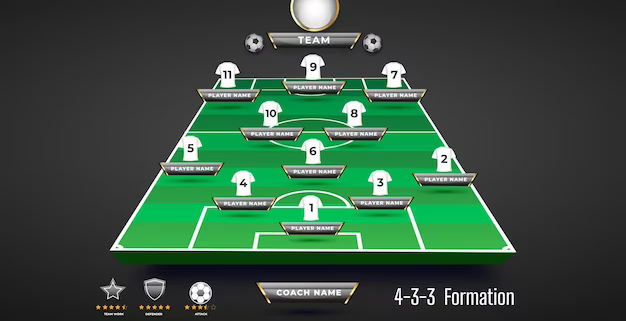
Many people see soccer as just a simple game of kicking a ball around, but it’s much more complex than that. Soccer involves different positions. Each soccer position has skills and responsibilities that help the team succeed. While some players can play in multiple positions, most specialize in just one.

Soccer positions are grouped into midfielders, defenders, and forwards. Each category has specific roles within it.

Let’s explore the importance of soccer positions and the skills needed to succeed in those roles.

Read more

Dynamic stretches for soccer performance

Dynamic stretching means moving your body parts through their full range of motion. Dynamic stretches involve active movements that get your muscles ready for the game. Warm-up stretches are especially important for soccer players. It helps increase blood flow to your muscles and raises your heart rate, preparing your body for physical activity. 

Read more

Soccer Jersey

Your soccer jersey is way more than just a simple shirt—it represents your love and passion for the game. Whether you’re cheering from the stands or playing on the field, your jersey sees a lot of action and needs proper care to stay in top shape. This is especially true for special jerseys, like a Kids Christian Pulisic Soccer Jersey, which young fans proudly wear to support their favorite player.

Here is a simple guide to help keep your football jersey looking colorful, fresh, and ready for game day. 

Read more